1. A Copernican Revolution
For those of us living on Earth, the Sun and Moon appear to revolve around our planet. Considering Earth to be the center of the universe was a perfectly natural idea based on everyday observations. However, when we attempt to describe the motion of planets such as Mercury and Mars from an Earth-centered perspective, their trajectories become extremely complicated.
In the 16th century, Nicolaus Copernicus proposed a model of planetary motion centered on the Sun rather than Earth.

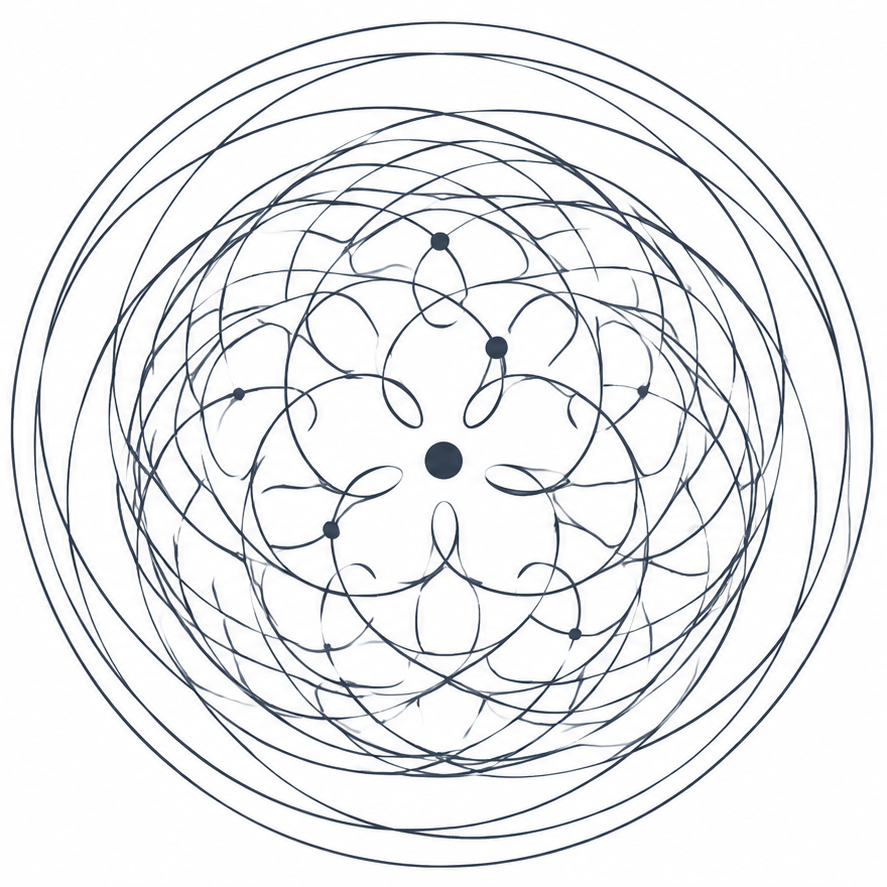
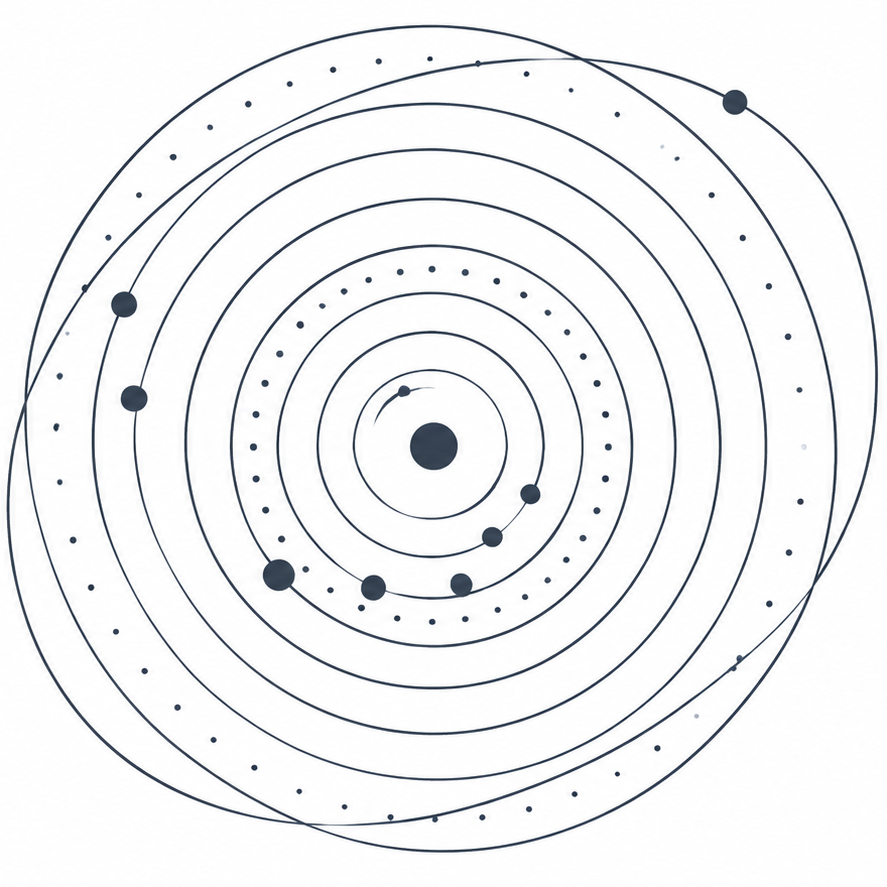
What matters here is that the motion of the planets itself did not change. What changed was the frame of reference used to describe that motion and our perception of the natural world. Such a fundamental reconsideration of established assumptions and frames of reference, leading to a profound change in our understanding, is known as a Copernican revolution.
2. The Law of Universal Gravitation and Coulomb’s Law
In the 17th century, Isaac Newton proposed the law of universal gravitation. The attractive force between two bodies is proportional to the product of their masses, \(m\) and \(M\), and inversely proportional to the square of the distance \(R\) between their centers.
Approximately a century later, Charles-Augustin de Coulomb discovered a similar law governing the electrostatic force between two charged particles. The magnitude of the electrostatic force is proportional to the absolute value of the product of their charges, \(q\) and \(Q\), and inversely proportional to the square of the distance \(r\) between them.
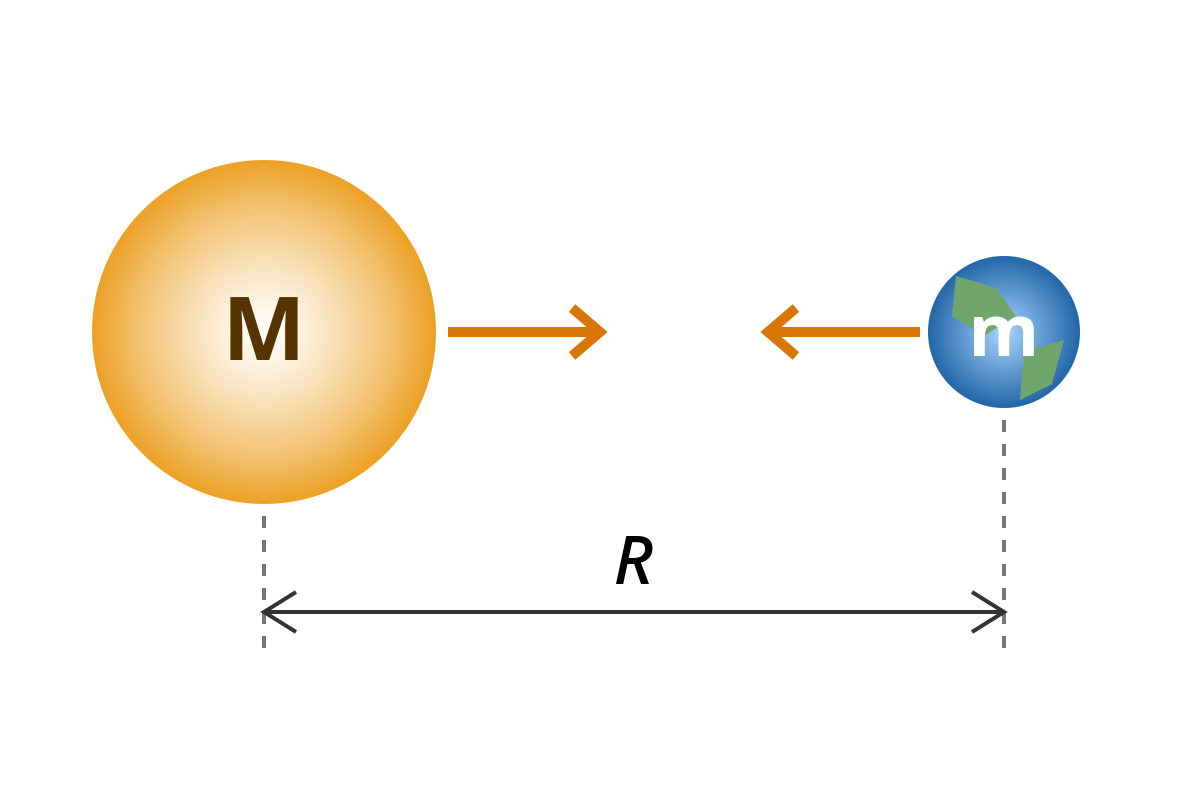
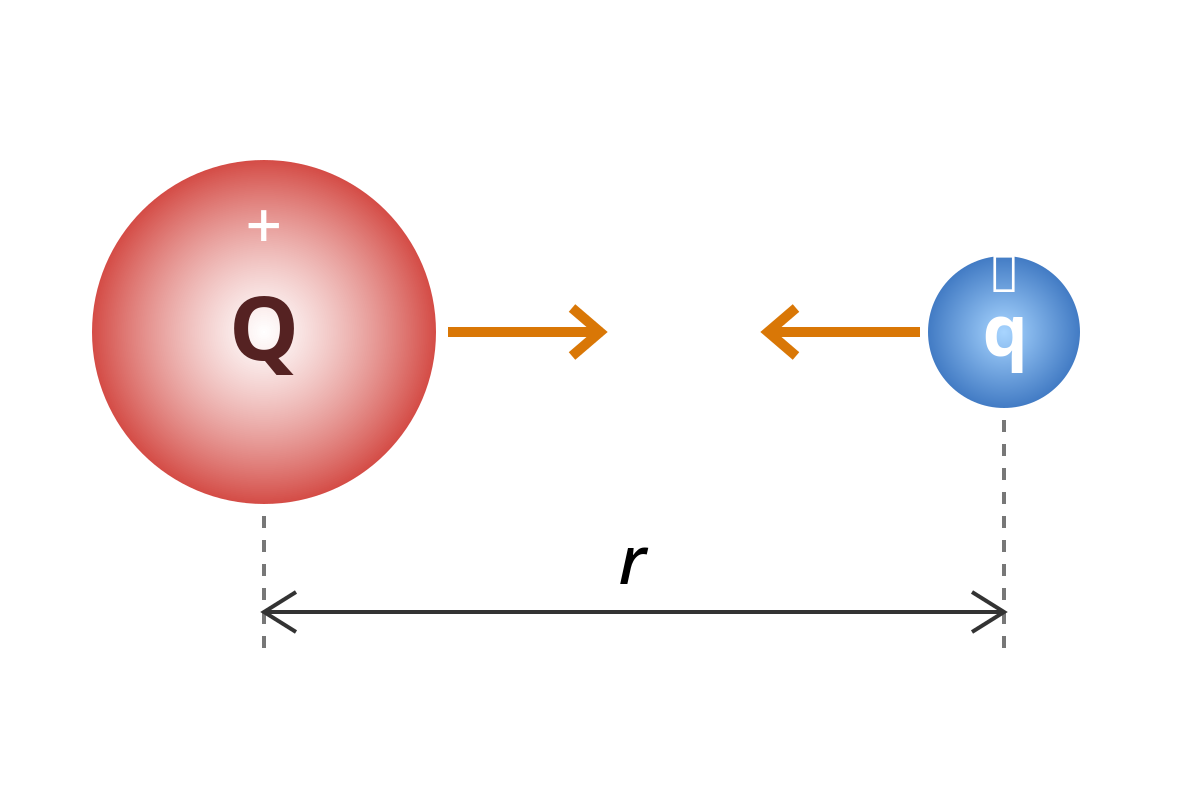
Here, \(G\) is the gravitational constant and \(k\) is the Coulomb constant. Although the law of universal gravitation and Coulomb’s law describe different physical phenomena, they share remarkably similar mathematical structures.
Taking these two laws as our starting point, we reconsider the roles of the gravitational constant \(G\), the Coulomb constant \(k\), the vacuum permittivity \(\varepsilon_0\), and the vacuum permeability \(\mu_0\), and ask whether mass (kilogram) and electric charge (coulomb) really need to be treated as independently defined units.
3. The SI Unit System
The International System of Units (SI; French: Système international d’unités), widely used throughout the world today, employs time (second), length (meter), mass (kilogram), and electric current (ampere) as base units for describing mechanics and electromagnetism. Let us revisit the historical origins of these units.
- Second: Originally defined as 1/86,400 of a day, based on Earth’s rotation.
- Meter: Originally defined as one ten-millionth of the distance from Earth’s equator to the North Pole along a meridian.
- Kilogram: Originally based on the mass of one liter of water.
- Ampere: Historically defined in terms of the electric current producing a specified force per unit length between two parallel conductors placed one meter apart in a vacuum.
Although these units have since been redefined in terms of universal physical constants, their magnitudes retain the historical scales established around human life and the terrestrial environment. In this sense, SI can be regarded as a human-centric unit system.
Just as describing planetary motion from an Earth-centered perspective made planetary trajectories appear complicated, might a human-centric unit system make the description of physical laws unnecessarily complicated?
In this article, we construct an electron-centric unit system based on the electron, one of the most fundamental particles in nature.
4. The ST Unit System
Taking the laws of universal gravitation and electrostatics discussed above as our starting point, and reconsidering the roles of the gravitational constant, the Coulomb constant, the vacuum permittivity, and the vacuum permeability, we can treat the units of both mass and electric charge as derived units expressed solely in terms of space and time. We refer to this system as the Space-Time Unit System (ST Unit System) (Reference).
In the ST Natural Unit System, the units of space and time are denoted by \(S\) and \(T\), respectively. The unit of mass is \(S^3/T^2\), and the unit of electric charge is \(S^2/T\). Furthermore, the elementary charge (\(e_0\)) and electron mass (\(m_0\)) are related by the following equation:
Here, \(c_0\) denotes the speed of light and equals \(1\ S/T\). To avoid confusion with SI, physical quantities in the ST Natural Unit System are denoted with a subscript zero in this article.
In the ST Natural Unit System, the numerical values of the speed of light, elementary charge, and electron mass are all unity.
These are not unrelated physical quantities arbitrarily set to unity. When the characteristic length is derived from established physical laws, it coincides with the classical electron radius.
Thus, by setting the classical electron radius to \(1\ S\) and the speed of light to \(1\ S/T\), the elementary charge and electron mass become \(1\ S^2/T\) and \(1\ S^3/T^2\), respectively, while dimensional consistency among physical quantities is preserved.
The ST Natural Unit System is a Dimensional Natural Unit System that simplifies the numerical values of physical quantities while retaining their physical dimensions in terms of space and time.
5. Defining Space and Time through Electrons and Photons
In special relativity, the speed of light is invariant, whereas space and time are relative. However, the very concept of the speed of light is defined as a ratio of space to time. In other words, defining the speed of light presupposes the existence of the concepts of space and time. Let us therefore take the photon as a physical entity, rather than the speed of light, as our starting point.
In the ST Unit System, rather than describing the physical properties of electrons and photons in terms of space and time, we can reverse this approach and define the units of space and time on the basis of the intrinsic physical properties of electrons and photons.
In this way, rather than taking space and time as the starting point of physics, we can derive their fundamental scales by starting from electrons and photons that exist in nature.
Since Paul Dirac predicted the existence of antiparticles, electron–positron annihilation has been experimentally confirmed and can now be observed even in undergraduate physics laboratory experiments.
Conversely, there is also the phenomenon of pair production, in which electrons and positrons possessing mass and electric charge are generated from photons that possess neither rest mass nor electric charge.
If the dimensions of mass and electric charge in Equation (1) are denoted by \(M\) and \(C\), respectively, the dimension of the speed of light can be written as
that is, as the ratio of mass to electric charge. At the same time, it can be written as
that is, as the ratio of space to time.
Thus, the following intriguing dimensional relationship holds in the ST Unit System:
It is as though photons enrich our physical world by bringing forth not only mass and electric charge, but even space and time, through pair production.
6. Particle Physics and Nuclear Physics
Equation (1), of course, expresses a relationship between the electron mass and the elementary charge and does not apply to all particles. The magnitude of the proton’s charge is likewise \(1\ S^2/T\), but its mass is approximately 1,836 times that of the electron. The proton contains three valence quarks, and complex physical phenomena arise within it through the strong interaction. Muons and tau particles, like electrons, are considered elementary particles with no internal structure, but they are unstable and decay through the weak interaction.
We therefore adopt the electron, a stable elementary particle with no internal structure, as our reference and express the masses and charges of other particles as ratios to the electron mass and elementary charge, respectively.
Particle Masses and Charges in the ST Natural Unit System
| Particle | Mass (\(S^3/T^2\)) | Charge (\(S^2/T\)) |
|---|---|---|
| Electron | 1 | −1 |
| Positron | 1 | +1 |
| Muon | 206.768 | −1 |
| Tau | ≈ 3,477 | −1 |
| Proton | 1,836.153 | +1 |
| Neutron | 1,838.684 | 0 |
| Photon | 0 | 0 |
Quark Masses and Charges in the ST Natural Unit System
| Particle | Mass (\(S^3/T^2\)) | Charge (\(S^2/T\)) |
|---|---|---|
| Up | ≈ 4.2 | +2/3 |
| Down | ≈ 9.1 | −1/3 |
| Charm | ≈ 2,485 | +2/3 |
| Strange | ≈ 183 | −1/3 |
| Top | ≈ 338,000 | +2/3 |
| Bottom | ≈ 8,180 | −1/3 |
Note: Quark masses depend on the renormalization scheme and energy scale. The values shown are approximate ratios of representative quark masses to the electron mass.
Furthermore, the dimension of energy in the ST Natural Unit System is given by
If the unit of energy is denoted by \(E\), the rest energy of the electron, based on mass–energy equivalence, is given by
Therefore, the rest energies of other particles can also be expressed using the same numerical values as their masses. For example, the proton has a mass of approximately \(1836\ S^3/T^2\) and a rest energy of approximately \(1836\ E\). There is consequently no need to introduce a separate energy scale such as the electronvolt (eV).
By taking the electron as our reference, the ST Unit System enables us to express particle masses, electric charges, and rest energies on a common scale, providing a simpler and more intuitive description of the physical world. Rather than defining units first and expressing physical laws within them, the ST unit system seeks to derive units from physical laws themselves. This is the essence of the Copernican revolution embodied in the ST unit system.
Reference
Note: This page introduces the concept of the ST Unit System. For further details, please refer to the following publication.
Space-Time Unit System for Unifying Gravitational Mechanics, Electromagnetism and Quantum Physics