During my time at Western Washington University, the experiment in which I most vividly felt physics "in my hands" was an electron-positron annihilation experiment. Two scintillators with photomultiplier tubes are placed on a circular rail facing each other, and a positron-emitting source is placed at the center. The emitted positrons lose energy through interactions with electrons in the surrounding air (or in matter), and eventually annihilate with electrons. In this annihilation process, the rest-mass energy of the electron and positron is converted into two gamma rays, each with energy 0.511 MeV, emitted in nearly opposite directions (back-to-back, ~180 degrees) (Fig.1).
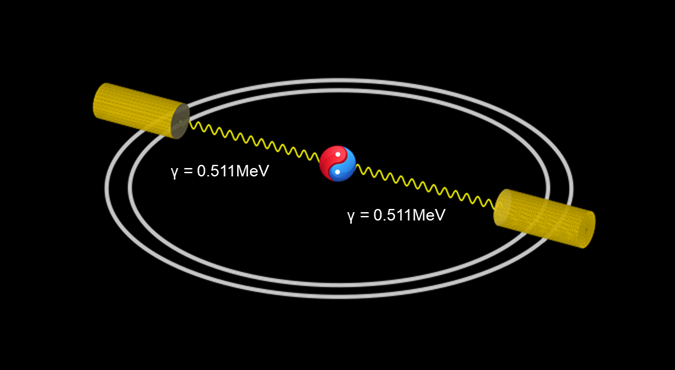
The value 0.511 MeV is the electron rest-mass energy given by one of the simplest and most celebrated equations in physics, Einstein's relation
where \(m_e\) is the electron mass, \(c\) is the speed of light, and \(E\) is the rest-mass energy. With this remarkably simple setup, one can directly "see" the meaning of Einstein's equation. Moreover, the back-to-back emission of two photons, together with the contrast between circular motion associated with charged particles and the linear propagation of photons, offers an intuitive view of symmetry in physical processes.
The phenomenon complementary to annihilation is pair creation (pair production), in which two photons generate an electron–positron pair. In other words, photons carrying neither charge nor rest mass transform into particles carrying both charge and mass. While Einstein's equation relates mass and energy, it does not explicitly include electric charge.
We propose a simple relation that simultaneously connects photons, charge, and mass. Starting from Newton's law of gravitation and Coulomb's law, we reexamine the roles of the gravitational constant \(G\), the vacuum permittivity \(\varepsilon_0\), and the vacuum permeability \(\mu_0\). We show that the SI units kilogram and coulomb can be transformed into purely space-time quantities as
(see Reference).
We call this framework the Space-Time (ST) unit system. In this system, the electron mass \(m_e\) is transformed into \(m_0\), and the elementary charge \(e\) is transformed into \(e_0\). As a result, a remarkably simple relation holds among photons, charge, and mass:
Like Einstein's equation, this expression is extremely concise, yet it aims to capture a fundamental structural relationship among mass, charge, and light.
Reference
Note : This page serves as an introductory overview. For full derivations and systematic discussions, please refer to:
Space-Time Unit System for Unifying Gravitational Mechanics, Electromagnetism and Quantum Physics